This function simulates a complete fMRI dataset by combining task-related signals with a declared structured-noise model. It returns both the clean signals and the noisy data.
Usage
simulate_simple_dataset(
  ncond,
  nreps = 12,
  TR = 1.5,
  snr = 0.5,
  hrf = fmrihrf::HRF_SPMG1,
  seed = NULL
)
Arguments
- ncond
Number of conditions to simulate
- nreps
Number of repetitions per condition (default is 12)
- TR
Repetition time in seconds (default is 1.5)
- snr
Finite positive signal-to-noise ratio, defined as the empirical standard deviation of the clean condition signals divided by the empirical standard deviation of the complete structured-noise matrix (default is 0.5)
- hrf
Hemodynamic response function to use (default is fmrihrf::HRF_SPMG1)
- seed
Optional seed for reproducibility (default is NULL). Reusing a seed with a different
snrpreserves the clean signal and standardized noise realization while changing only the noise scale.
Value
A list containing:
clean: The simulated signals without noise (from simulate_bold_signal)
noisy: The signals with added noise
noise: The simulated noise component
onsets: Trial onset times
conditions: Condition labels for each trial
Examples
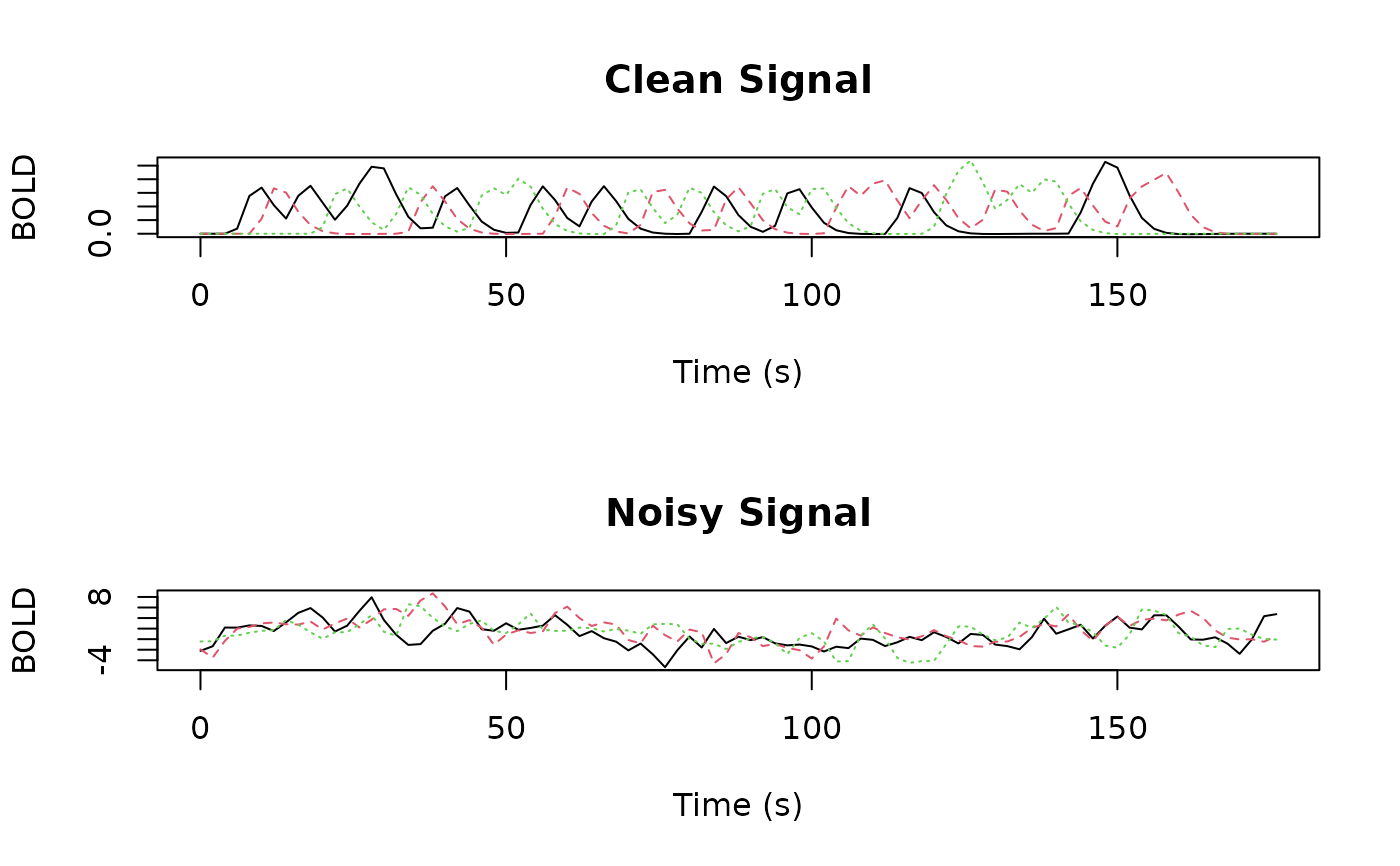
# Simulate a dataset with 3 conditions
data <- simulate_simple_dataset(ncond = 3, TR = 2, snr = 0.5)
# Plot clean and noisy data
old_par <- par(no.readonly = TRUE)
par(mfrow = c(2,1))
matplot(data$clean$mat[,1], data$clean$mat[,-1], type = "l",
main = "Clean Signal", xlab = "Time (s)", ylab = "BOLD")
matplot(data$noisy[,1], data$noisy[,-1], type = "l",
main = "Noisy Signal", xlab = "Time (s)", ylab = "BOLD")
 par(old_par)