Overview
gpca_align() implements Generalized PCA alignment. It
constructs a coupled metric across domains and then solves a generalized
PCA problem to obtain a shared latent embedding. The helper
gpca_align_control() exposes safeguards for graph
sparsification, label balancing and dense-matrix memory limits, making
it practical on real data.
This vignette walks through a minimal pipeline:
- Load a reusable hyperdesign dataset with three related domains.
- Run
gpca_align()and inspect the aligned scores. - Tune graph sparsity and balancing with
gpca_align_control().
The code below only relies on public package APIs, so you can copy–paste it when exploring your own data.
Constructing a Hyperdesign
We reuse the packaged benchmark dataset so every alignment vignette operates on identical inputs. It contains three domains with two latent classes and moderate domain-specific transformations.
alignment_benchmark <- manifoldalign::alignment_benchmark
domain_list <- lapply(alignment_benchmark$domains, function(dom) {
  multidesign(dom$x, dom$design)
})
hd <- hyperdesign(domain_list)
labels <- alignment_benchmark$labels
domain_names <- names(domain_list)
domain_sizes <- vapply(domain_list, function(dom) nrow(dom$x), integer(1))
When data is a hyperdesign, call
gpca_align() and supply the label column name via the
y argument.
base_preproc <- replicate(length(domain_names), multivarious::pass(), simplify = FALSE)

gpca_fit <- gpca_align(
  hd,
  y = condition,
  ncomp = 2,
  u = 0.6,           # balance within/between alignment
  lambda = 1e-2,     # light ridge regularisation
  preproc = base_preproc
)

str(gpca_fit, max.level = 1)
#> List of 6
#>  $ v            : num [1:12, 1:2] -0.342 -0.361 -0.294 -0.246 -0.306 ...
#>   ..- attr(*, "dimnames")=List of 2
#>  $ preproc      :List of 2
#>   ..- attr(*, "class")= chr [1:2] "concat_pre_processor" "pre_processor"
#>  $ s            : num [1:240, 1:2] -0.112 -0.153 -0.161 -0.201 -0.148 ...
#>   ..- attr(*, "dimnames")=List of 2
#>  $ sdev         : num [1:2] 5.94 5.22
#>  $ block_indices:List of 3
#>  $ labels       : Factor w/ 2 levels "class_A","class_B": 1 1 1 1 1 1 1 1 1 1 ...
#>  - attr(*, "class")= chr [1:5] "gpca_align" "multiblock_biprojector" "multiblock_projector" "bi_projector" ...
#>  - attr(*, ".cache")=<environment: 0x560736f19bc0>
rms_alignment(as.matrix(gpca_fit$s), domain_sizes, domain_names)
#> # A tibble: 3 × 3
#>   domain_i domain_j    rms
#>   <chr>    <chr>     <dbl>
#> 1 domain1  domain2  0.205
#> 2 domain1  domain3  0.231
#> 3 domain2  domain3  0.0333
The result is a multiblock_biprojector, so we can
extract scores and feature loadings just like other
multivarious models. For plotting below we z-score the
aligned scores so that the scale matches other vignettes.
You can optionally pass a domain-specific preprocessing list (e.g.
list(center(), center(), center())) if you want to centre
or scale each block before alignment. Passing the
base_preproc list (built above with
multivarious::pass()) keeps preprocessing as the
identity—which keeps this example lightweight while still supporting
different feature dimensions.
score_tbl <- as_tibble(zscore_columns(as.matrix(gpca_fit$s)), .name_repair = "minimal")
colnames(score_tbl) <- paste0("comp", seq_len(ncol(score_tbl)))

scores <- score_tbl %>%
  mutate(
    sample = seq_len(nrow(.)),
    domain = rep(domain_names, times = domain_sizes),
    condition = rep(labels, length(domain_names))
  )

head(scores)
#> # A tibble: 6 × 5
#>    comp1 comp2 sample domain  condition
#>    <dbl> <dbl>  <int> <chr>   <fct>
#> 1 -0.819 0.674      1 domain1 class_A
#> 2 -1.48  1.38       2 domain1 class_A
#> 3 -1.18  1.11       3 domain1 class_A
#> 4 -1.95  1.96       4 domain1 class_A
#> 5 -1.08  0.997      5 domain1 class_A
#> 6 -1.45  1.33       6 domain1 class_A
Visualising the Shared Embedding
 ggplot(scores, aes(x = comp1, y = comp2, colour = condition, shape = domain)) +
  geom_point(size = 2.2, alpha = 0.85) +
  labs(
    title = "GPCA alignment: shared 2D embedding",
    x = "Component 1",
    y = "Component 2"
  ) +
  theme_minimal()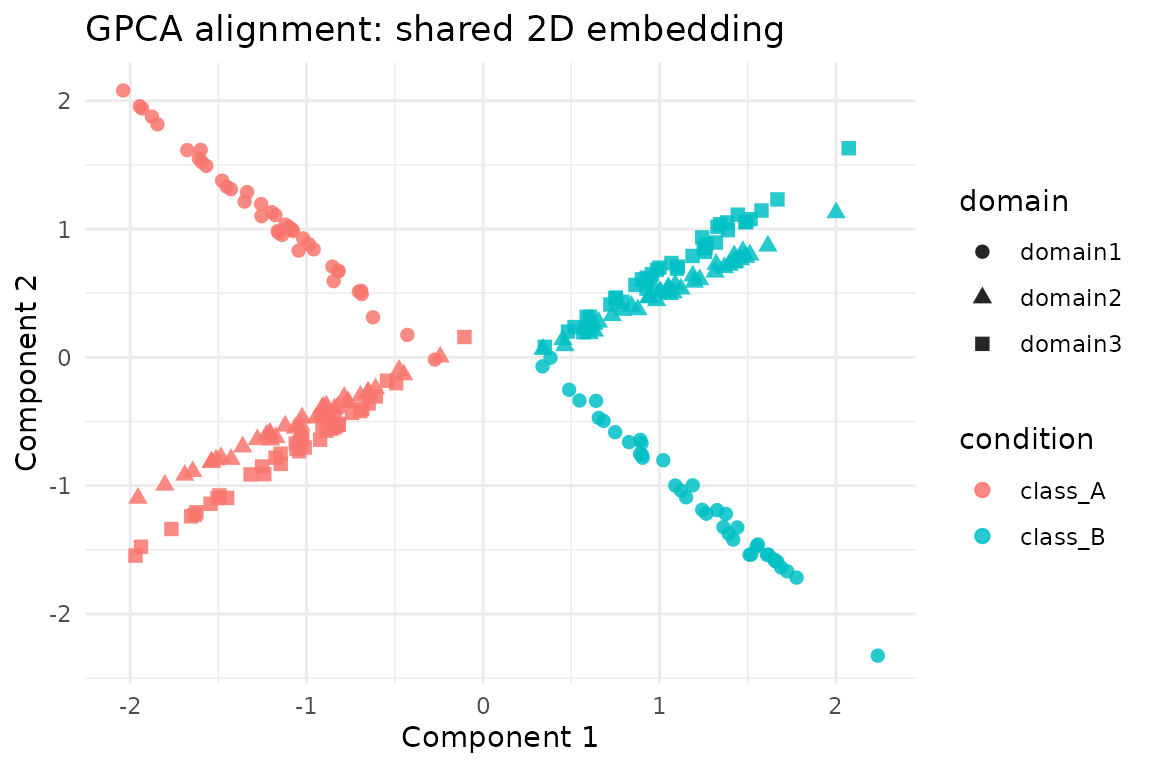
Controlling Graph Sparsification and Balancing
The optional control argument feeds through to
gpca_align_control(), letting you adjust k-NN
sparsification, label balancing and memory caps. Here we build a denser
within-domain graph but down-weight the majority class via label
balancing.
ctrl <- gpca_align_control(
  knn = 10,
  knn_mode = "mutual",
  balance = "within",
  balance_power = 0.5,
  normalize = "edges",
  verbose = FALSE
)

gpca_dense <- gpca_align(
  hd,
  y = condition,
  ncomp = 2,
  control = ctrl,
  preproc = base_preproc
)

summary(gpca_dense$sdev)
#>    Min. 1st Qu.  Median    Mean 3rd Qu.    Max.
#>   5.633   5.703   5.773   5.773   5.843   5.912
When working with larger domains, consider leaving
knn = NA (the default) to use fully dense metrics or lower
the max_dense_elems parameter to enforce a safe memory
ceiling. If gpca_align() detects that densifying the block
matrix would exceed the limit, it aborts with a diagnostic message so
you can tighten the sparsification or dimensionality reduction
beforehand.
Next Steps
-
gpca_align()returns a standardmultivariousprojector, so you can callpredict()on new samples (viamultivarious::multiblock_biprojector). - The RMS alignment summary above shows how closely each domain pair agrees in the coupled space; values near zero indicate strong agreement.
- Use
gpca_align_control()to add sparsification or label balancing when operating at larger scale. - Pair
gpca_align()withkema()orgrasp()in the same pipeline to compare linear vs kernel alignment strategies.
This vignette is intentionally lightweight—swap in your own domains or expand chunks to benchmark larger settings.