Why iPCA?
When you run PCA on concatenated multi-block data, blocks with more variables or higher variance dominate the result. MFA addresses this by normalizing each block’s first singular value to 1. But this is a single global correction — it doesn’t adapt to the actual signal content of each block.
Integrative PCA (iPCA) takes a different approach. It applies
per-block multiplicative penalties that continuously reweight
each block’s contribution based on how well it aligns with the emerging
shared structure. The penalty strength lambda controls how
aggressively blocks are equalized: small lambda approaches
standard PCA, large lambda gives each block equal influence
regardless of size.
iPCA was introduced by Tang and Allen (2021) and implemented here using an efficient Flip-Flop algorithm.
Quick start
sim <- synthetic_multiblock(
  S = 4, n = 60,
  p = c(20, 30, 15, 25),
  r = 3, sigma = 0.3, seed = 42
)
sapply(sim$data_list, dim)
#>      [,1] [,2] [,3] [,4]
#> [1,]   60   60   60   60
#> [2,]   20   30   15   25
Fit iPCA with a moderate penalty:
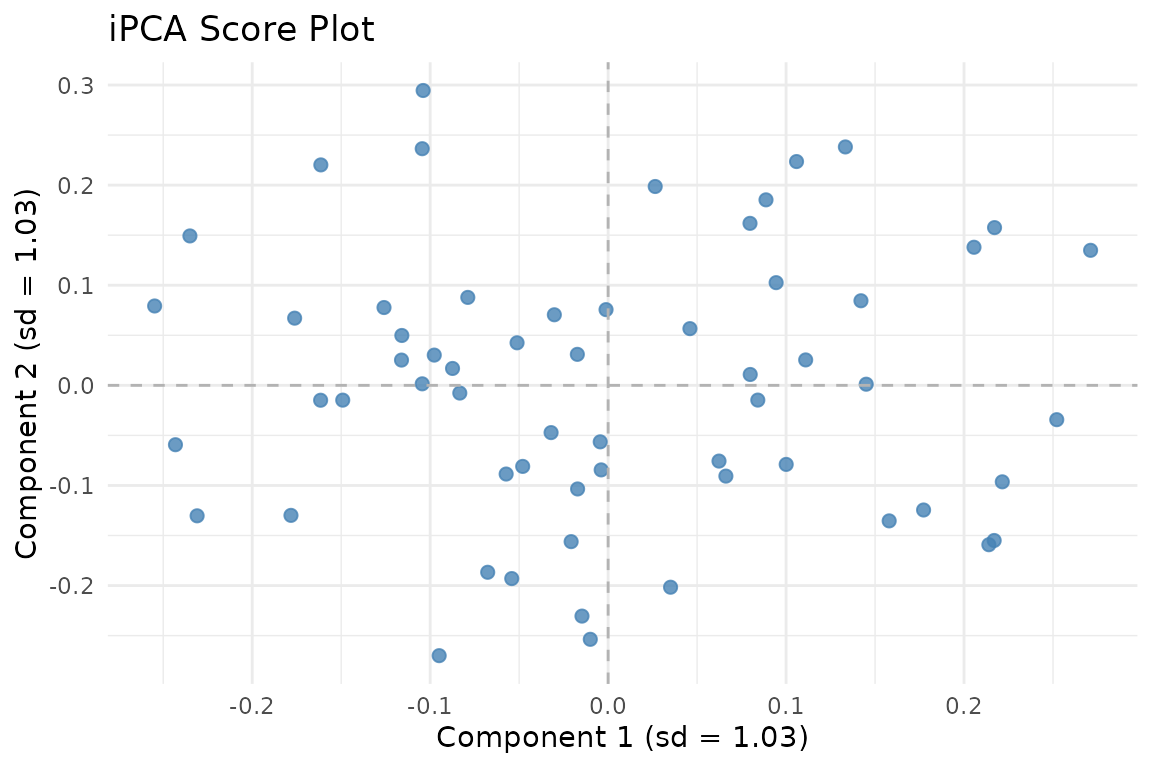
iPCA scores. The multiplicative penalty balances block contributions while preserving shared structure.
How iPCA works
iPCA solves a penalized eigenvalue problem. For blocks , it finds shared eigenvectors by maximizing:
where is a concave penalty function (the multiplicative Frobenius penalty). This upweights blocks that align well with the current direction and downweights those that don’t — a soft, adaptive form of integration.
The lambda parameter
lambda controls the integration strength:
-
lambdanear 0: Standard PCA on concatenated data (no reweighting). Blocks with more variables dominate. -
lambda = 1: Moderate integration. Blocks are softly equalized. -
Large
lambda(10+): Strong equalization. Every block contributes roughly equally, regardless of size.
fit_low  <- ipca(sim$data_list, ncomp = 3, lambda = 0.01)
fit_high <- ipca(sim$data_list, ncomp = 3, lambda = 10)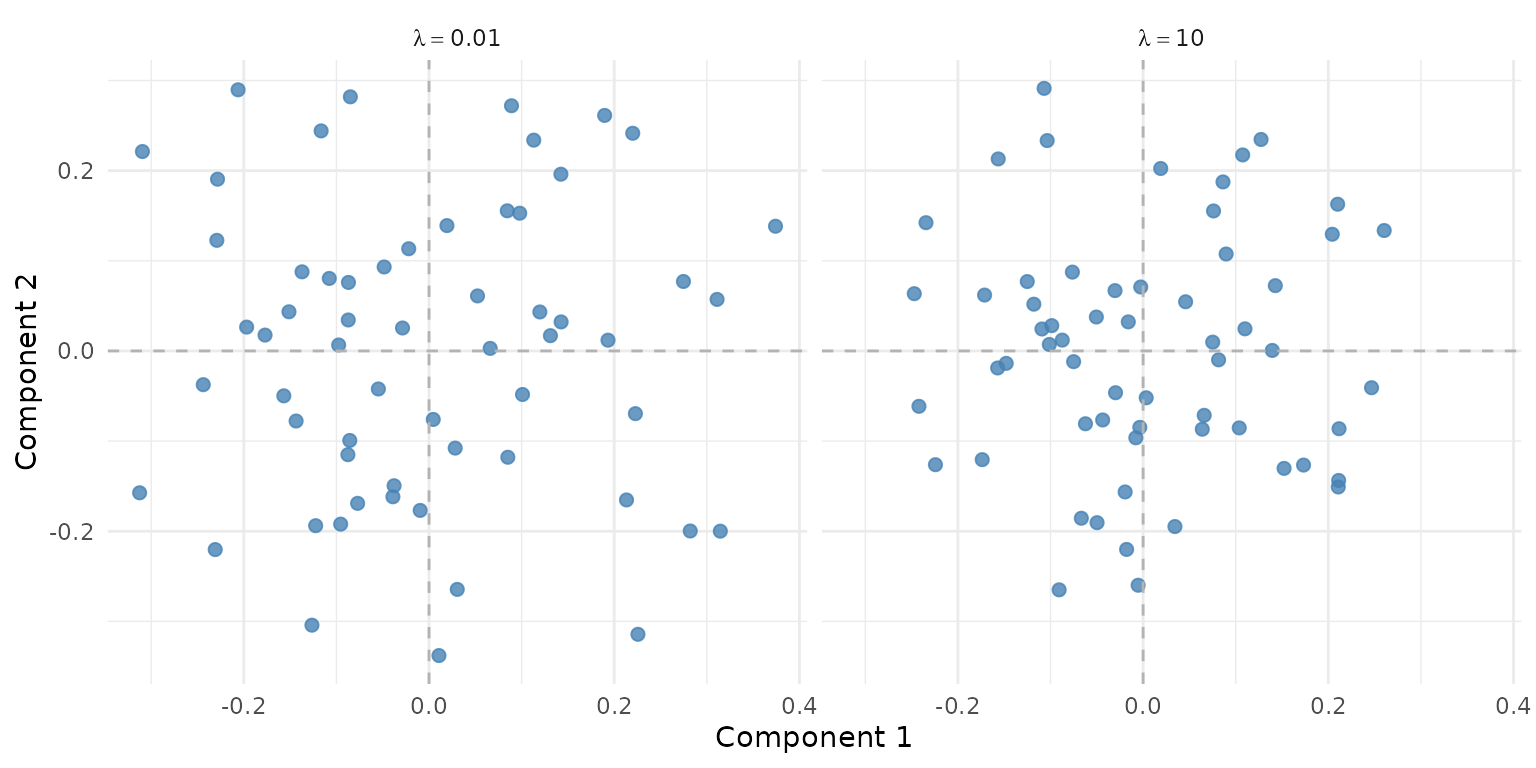
Effect of lambda on the score space. Low lambda (left) lets larger blocks dominate; high lambda (right) equalizes contributions.
Tuning lambda with held-out data
ipca_tune_alpha() selects the optimal penalty by holding
out a fraction of the data and measuring reconstruction error:
tune <- ipca_tune_alpha(
  sim$data_list, ncomp = 3,
  alpha_grid = c(0.01, 0.1, 1, 10),
  holdout_frac = 0.1
)
tune$best_alpha
#> [1] 10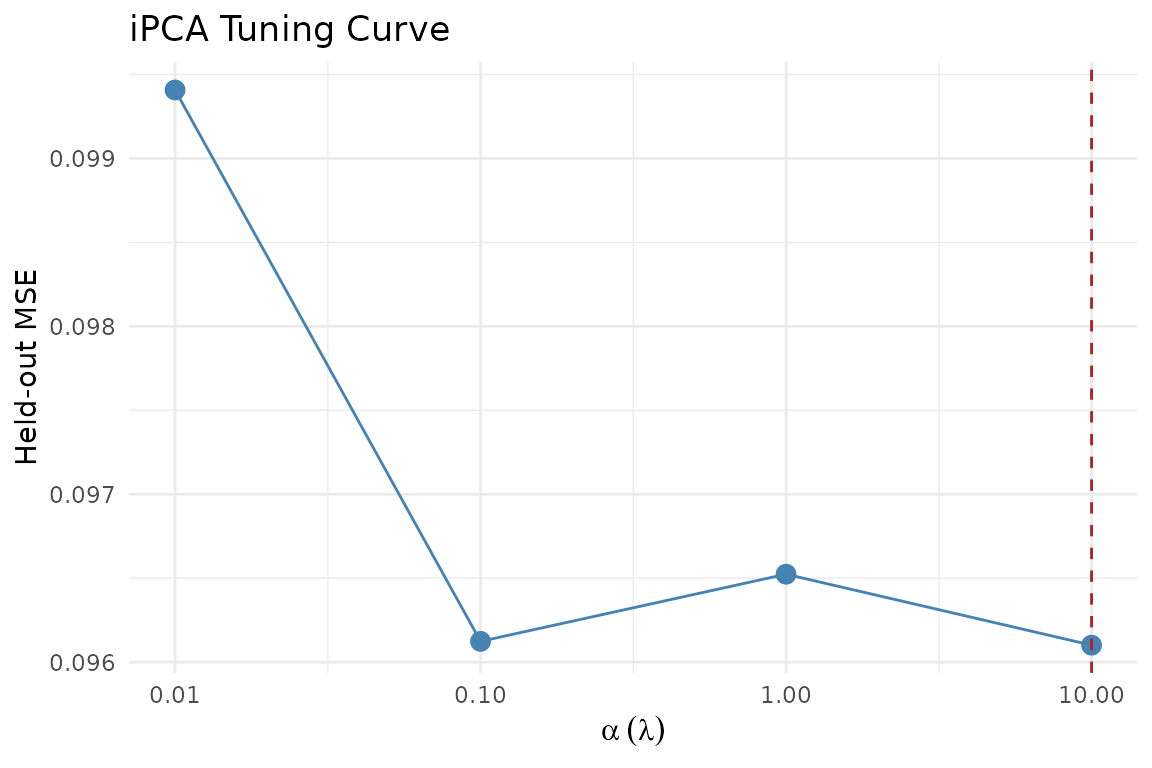
Held-out MSE across alpha (lambda) values. Lower is better.
The tuning result includes a refit on the full data at the best alpha:
Partial scores
Each block contributes its own view of the observations through per-block loadings:
# Per-block scores
ps <- fit$partial_scores
sapply(ps, dim)
#>      B1 B2 B3 B4
#> [1,] 60 60 60 60
#> [2,]  3  3  3  3
Projection
Project new observations onto the fitted model. You pass a list of blocks with the same structure as the training data:
Inference and validation
iPCA now participates in the same generic evaluation surface as MFA.
Use infer_muscal() for resampling-based summaries, and
cv_muscal() when you want explicit fold-wise reconstruction
metrics.
boot <- infer_muscal(
  fit,
  method = "bootstrap",
  statistic = "sdev",
  nrep = 6,
  seed = 303
)

boot$summary
#> # A tibble: 3 × 7
#>   component label observed  mean      sd lower upper
#>       <int> <chr>    <dbl> <dbl>   <dbl> <dbl> <dbl>
#> 1         1 comp1     1.03  1.07 0.0134   1.06  1.09
#> 2         2 comp2     1.03  1.06 0.00881  1.05  1.07
#> 3         3 comp3     1.03  1.05 0.00476  1.04  1.05
perm <- infer_muscal(
  fit,
  method = "permutation",
  statistic = "sdev",
  nrep = 9,
  seed = 404
)

perm$component_results
#> # A tibble: 3 × 6
#>   component label observed p_value lower_ci upper_ci
#>       <int> <chr>    <dbl>   <dbl>    <dbl>    <dbl>
#> 1         1 comp1     1.03     0.8     1.03     1.04
#> 2         2 comp2     1.03     0.7     1.03     1.03
#> 3         3 comp3     1.03     0.8     1.03     1.03
stopifnot(all(is.finite(boot$summary$mean)))
stopifnot(all(boot$summary$upper >= boot$summary$lower))
stopifnot(all(perm$component_results$p_value >= 0))
stopifnot(all(perm$component_results$p_value <= 1))
For a package-level walkthrough of infer_muscal(),
cv_muscal(), and the task-aware metric registry, see
vignette("model_evaluation").
Computation methods
iPCA supports two internal methods:
-
"gram"(default for wide data): Works in sample space (). Efficient when blocks have more variables than observations. -
"dense": Works in variable space. Better for tall data.
The "auto" setting (default) picks the right method
based on data dimensions.
# Force gram mode for high-dimensional blocks
fit_gram <- ipca(sim$data_list, ncomp = 3, lambda = 1, method = "gram")
When to use iPCA
iPCA is appropriate when:
- You have multiple data blocks on the same observations
- You want adaptive, data-driven integration (vs. MFA’s fixed normalization)
- Blocks vary substantially in dimensionality or signal strength
- You want a tunable integration strength
iPCA is not appropriate when:
- Blocks have different observations (use
anchored_mfa()) - You need classical MFA block weights for interpretation (use
mfa()) - Your data are covariance matrices (use
covstatis())
Next steps
-
vignette("mfa")— Classical MFA with fixed normalization -
vignette("model_evaluation")— Generic inference and held-out evaluation workflows -
vignette("penalized_mfa")— MFA with loading similarity penalties -
?ipca_tune_alpha— Detailed tuning options