Generalized PLS-SVD: Explicit Whitening Reference
Source:vignettes/gplssvd-reference.Rmd
gplssvd-reference.RmdStart here to relate two data blocks measured on the same
observations. The first example fits genpls() and projects
both blocks into latent coordinates. The later sections provide a dense
reference for contributors checking the whitening identities behind
gplssvd_op().
Quick practical use
Rows must refer to the same observations in the same order. Here
X has 150 rows and 8 variables, Y has 150 rows
and 5 variables, and both contain one shared simulated signal. The
example metrics are positive diagonal weights.
set.seed(123)
N <- 150
shared <- rnorm(N)
X <- outer(shared, seq(0.5, 1.2, length.out = 8)) + matrix(rnorm(N * 8), N, 8)
Y <- outer(shared, seq(0.5, 1.2, length.out = 5)) + matrix(rnorm(N * 5), N, 5)
row_wt   <- diag(runif(N, 0.5, 1.5))
col_wt_x <- diag(runif(8, 0.8, 1.2))
col_wt_y <- diag(runif(5, 0.8, 1.2))

fit <- genpls(X, Y, ncomp = 2,
              preproc_x = multivarious::center(),
              preproc_y = multivarious::center(),
              Mx = row_wt, My = row_wt,
              Ax = col_wt_x, Ay = col_wt_y)
round(fit$d, 3)
#> [1] 560.652  62.966
Project each block using its fitted preprocessing and projection weights:
Sx <- multivarious::project(fit, X)
Sy <- multivarious::project(fit, Y, source = "Y")
cor(Sx[, 1], Sy[, 1])
#> [1] 0.8086014
Leading projected coordinates of the two blocks, which share a simulated signal.
The leading coordinates track the shared variation. This is a
training-data association, not a held-out predictive assessment. For new
observations, pass matrices with the same columns to
project() in the same way. With nonidentity row metrics
these ambient coordinates differ from the stored row-whitened
lx and ly used in the identities below.
Reference for contributors
Notation
GPLSSVD decomposes the relationship between two data blocks
X (N x I) and Y
(N x J) with optional row and column metrics:
-
MX,MY: row metrics (N x N) – weight observations differently for the two blocks -
WX,WY: column metrics (I x IandJ x J) – encode within-block variable relationships -
p,q: generalized singular vectors (saliences) satisfyingp' WX p = I,q' WY q = I -
Fi,Fj: factor scores (loadings scaled by singular values) -
Lx,Ly: latent variables (data projections onto components) -
d: singular values of the whitened cross-product matrix
Reference implementation
The function below builds the whitened cross-product
S = (M_X^{1/2} X W_X^{1/2})' (M_Y^{1/2} Y W_Y^{1/2})
explicitly and runs a dense SVD. It is deliberately the most literal
transcription of the algebra above, with no attention to speed or to
input types beyond what the check below needs; the package’s operator
path can apply the corresponding products without explicitly assembling
these matrices, with dense fallbacks where needed.
Everything rests on one helper. Each metric enters through its symmetric PSD square root, and singular metrics need the pseudo-inverse of that root – zero eigenvalues stay zero rather than blowing up. This small reference assumes valid PSD inputs; it is not a replacement for package validation or numerical rank handling:
psd_sqrt <- function(W, n) {
  if (is.null(W)) return(list(h = diag(n), hinv = diag(n), full = diag(n)))
  W    <- as.matrix(W)
  e    <- eigen(W, symmetric = TRUE)
  lam  <- pmax(e$values, 0)                    # PSD assumed; clip numerical negatives
  half <- function(f) e$vectors %*% (f * t(e$vectors))
  list(h    = half(sqrt(lam)),                 # W^{1/2}
       hinv = half(ifelse(lam > 0, 1 / sqrt(lam), 0)),  # W^{-1/2}, pseudo
       full = W)
}
The decomposition itself is then a whitening, one SVD, and an unwhitening:
dense_gplssvd_ref <- function(X, Y, MX = NULL, MY = NULL,
                              WX = NULL, WY = NULL, k = NULL,
                              center = FALSE, scale = FALSE) {
  X <- scale(as.matrix(X), center = center, scale = scale)
  Y <- scale(as.matrix(Y), center = center, scale = scale)
  stopifnot(nrow(X) == nrow(Y))

  mx <- psd_sqrt(MX, nrow(X)); wx <- psd_sqrt(WX, ncol(X))
  my <- psd_sqrt(MY, nrow(Y)); wy <- psd_sqrt(WY, ncol(Y))

  # whiten both blocks, then SVD their cross-product
  S  <- crossprod(mx$h %*% X %*% wx$h, my$h %*% Y %*% wy$h)
  sv <- svd(S)
  keep <- seq_len(if (is.null(k)) length(sv$d) else min(k, length(sv$d)))

  # unwhiten: saliences are W^{-1/2} u, so that p' WX p = I
  p <- wx$hinv %*% sv$u[, keep, drop = FALSE]
  q <- wy$hinv %*% sv$v[, keep, drop = FALSE]
  D <- diag(sv$d[keep], nrow = length(keep))

  list(d  = sv$d[keep], p = p, q = q,
       fi = wx$full %*% p %*% D,             # factor scores
       fj = wy$full %*% q %*% D,
       lx = mx$h %*% X %*% wx$full %*% p,    # latent variables
       ly = my$h %*% Y %*% wy$full %*% q)
}
Cross-checking the operator
Run the reference on a small block, run gplssvd_op()
with the same metrics, and compare:
set.seed(1)
N <- 20; I <- 8; J <- 6
X  <- matrix(rnorm(N * I), N, I)
Y  <- matrix(rnorm(N * J), N, J)
MX <- diag(runif(N, .5, 1.5))
MY <- diag(runif(N, .5, 1.5))
WX <- diag(runif(I, .5, 1.5))
WY <- diag(runif(J, .5, 1.5))

ref <- dense_gplssvd_ref(X, Y, MX, MY, WX, WY,
                         k = 3, center = TRUE, scale = FALSE)
op  <- gplssvd_op(X, Y,
                  XLW = MX, YLW = MY,
                  XRW = WX, YRW = WY,
                  k = 3, center = TRUE, scale = FALSE)

all.equal(ref$d, op$d, tolerance = 1e-6)
#> [1] TRUE
all.equal(diag(crossprod(op$lx, op$ly)), op$d, tolerance = 1e-6)
#> [1] TRUE
round(op$d, 4)
#> [1] 22.0777 19.9684 12.8428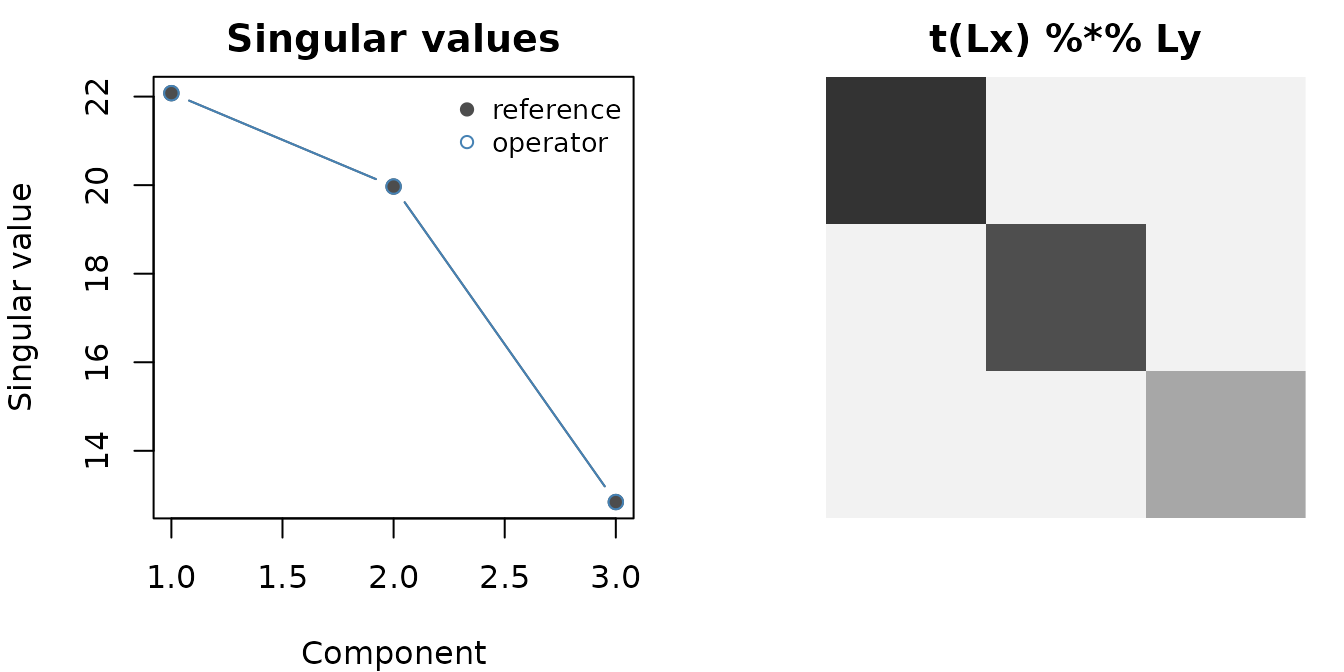
Reference vs operator singular values agree to plotting precision (left). Latent variables show the expected diagonal cross-product structure (right).
The diagonal of t(Lx) %*% Ly recovers the singular
values, as the GPLSSVD identity guarantees.
Where next
See Getting Started for a getting-started walkthrough and GPCA Metrics for metric recipes that apply to both GPCA and GPLSSVD.