Creates a flexible weighted HRF starting at t=0 with user-specified weights. Unlike traditional HRFs, this has no built-in hemodynamic delay - it directly maps weights to time points, allowing for arbitrary temporal response shapes.
Usage
hrf_weighted(
  weights,
  width = NULL,
  times = NULL,
  method = c("constant", "linear"),
  normalize = FALSE
)
Arguments
- weights
Numeric vector of weights. Required.
- width
Total duration of the window in seconds. If provided without
times,[0, width)is divided intolength(weights)equal bins (constant method), or the weights are placed at evenly spaced points from 0 towidth(linear method).- times
Numeric vector of time points (in seconds, relative to t=0) where weights are specified. Must be strictly increasing and start at 0 for consistency with other HRFs. If provided,
widthis ignored.- method
Interpolation method between time points:
- "constant"
Step function (default): each weight applies to one time bin. With
times, weighticovers[times[i], times[i + 1])and the last weight covers a bin as wide as the one before it. Every weight is used.- "linear"
Linear interpolation between points. Good for smooth weight transitions.
- normalize
Logical; if
TRUE, weights are scaled so all of them sum to 1 (formethod = "constant") or the curve integrates to 1 (formethod = "linear"). This fixes the scale of the weight profile; see Details for what the regression coefficient estimates. Default isFALSE.
Value
An HRF object that can be used with regressor() and other
fmrihrf functions.
Details
This is useful for summarising the signal in chosen post-stimulus windows with a chosen temporal profile. In a least-squares GLM, an isolated event's coefficient is the amplitude of the weight profile \(w(t)\) that best matches the data, \(\sum_t w(t) y(t) / \sum_t w(t)^2\). This equals the mean signal in the window only when all non-zero weights are 1 (a boxcar); in general it is not a weighted mean. Normalizing rescales the coefficient but does not change this.
There are two ways to specify the temporal structure:
width + weights: the window[0, width)is divided intolength(weights)equal bins (constant method) or the weights are placed at evenly spaced points from 0 towidth(linear method)times + weights: explicit time points for each weight (relative to t=0)
For delayed windows (not starting at t=0), use lag_hrf to shift
the weighted HRF in time.
Note on durations
The temporal structure (width or times) is fixed when the HRF
is created. The duration parameter in regressor() does
not modify the weighted HRF's structure—it controls how long the
neural input is sustained (which then gets convolved with this HRF). For
trial-varying weighted HRFs, use a list of HRFs:
hrf_early <- hrf_weighted(width = 6, weights = c(1, 1, 0, 0), normalize = TRUE)
hrf_late <- hrf_weighted(width = 6, weights = c(0, 0, 1, 1), normalize = TRUE)
reg <- regressor(onsets = c(0, 20), hrf = list(hrf_early, hrf_late))
See also
hrf_boxcar for simple uniform boxcars,
lag_hrf to shift the window in time,
empirical_hrf for HRFs from measured data
Other hrf_functions:
hrf_basis_lwu(),
hrf_boxcar(),
hrf_bspline(),
hrf_gamma(),
hrf_gaussian(),
hrf_inv_logit(),
hrf_lwu(),
hrf_mexhat(),
hrf_sine(),
hrf_spmg1(),
hrf_time()
Examples
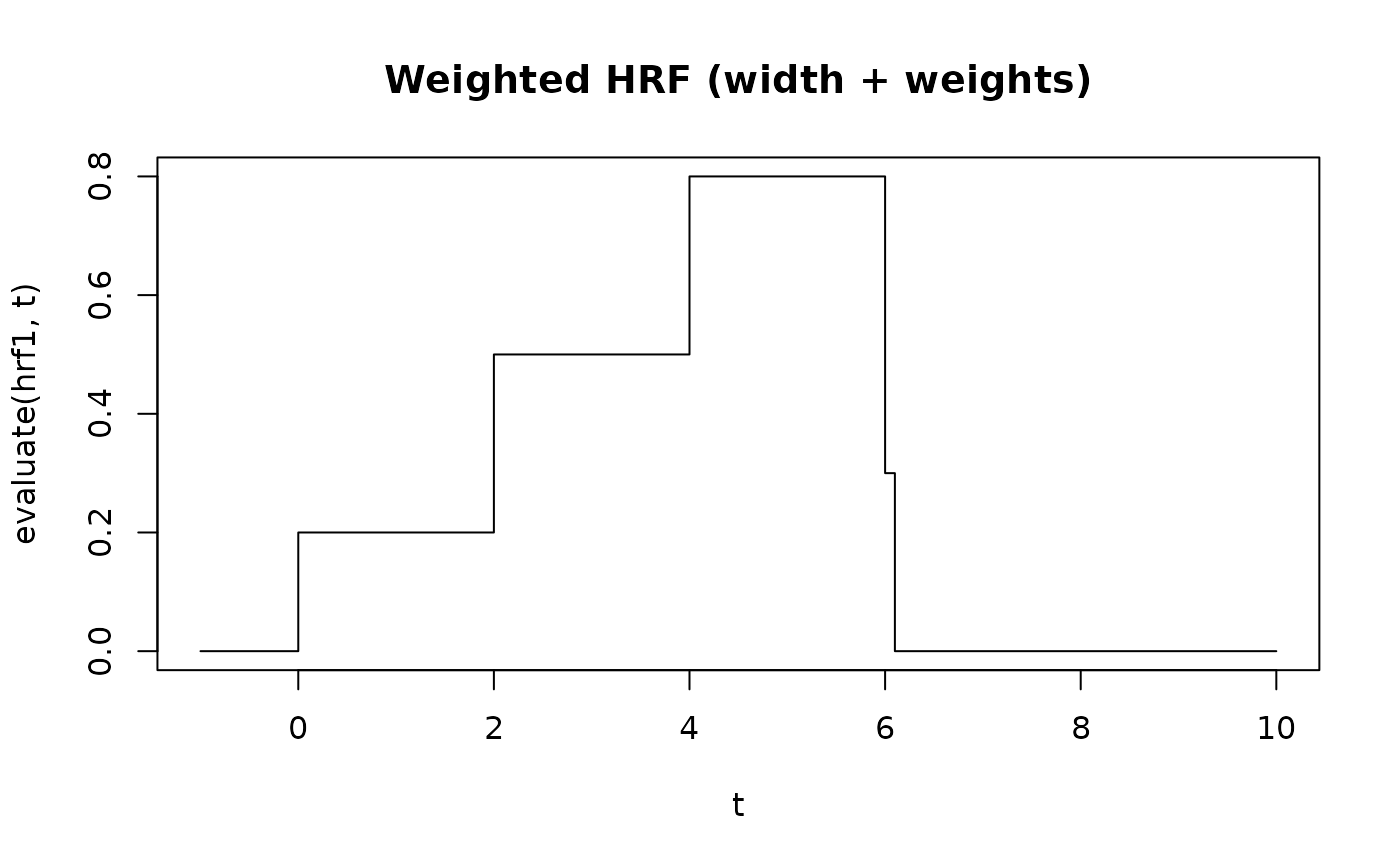
# Simple: 6 s window split into 4 bins of 1.5 s (starting at 0, 1.5, 3, 4.5 s)
hrf1 <- hrf_weighted(width = 6, weights = c(0.2, 0.5, 0.8, 0.3))
t <- seq(-1, 10, by = 0.1)
plot(t, evaluate(hrf1, t), type = "s", main = "Weighted HRF (width + weights)")
 # Explicit times for precise control
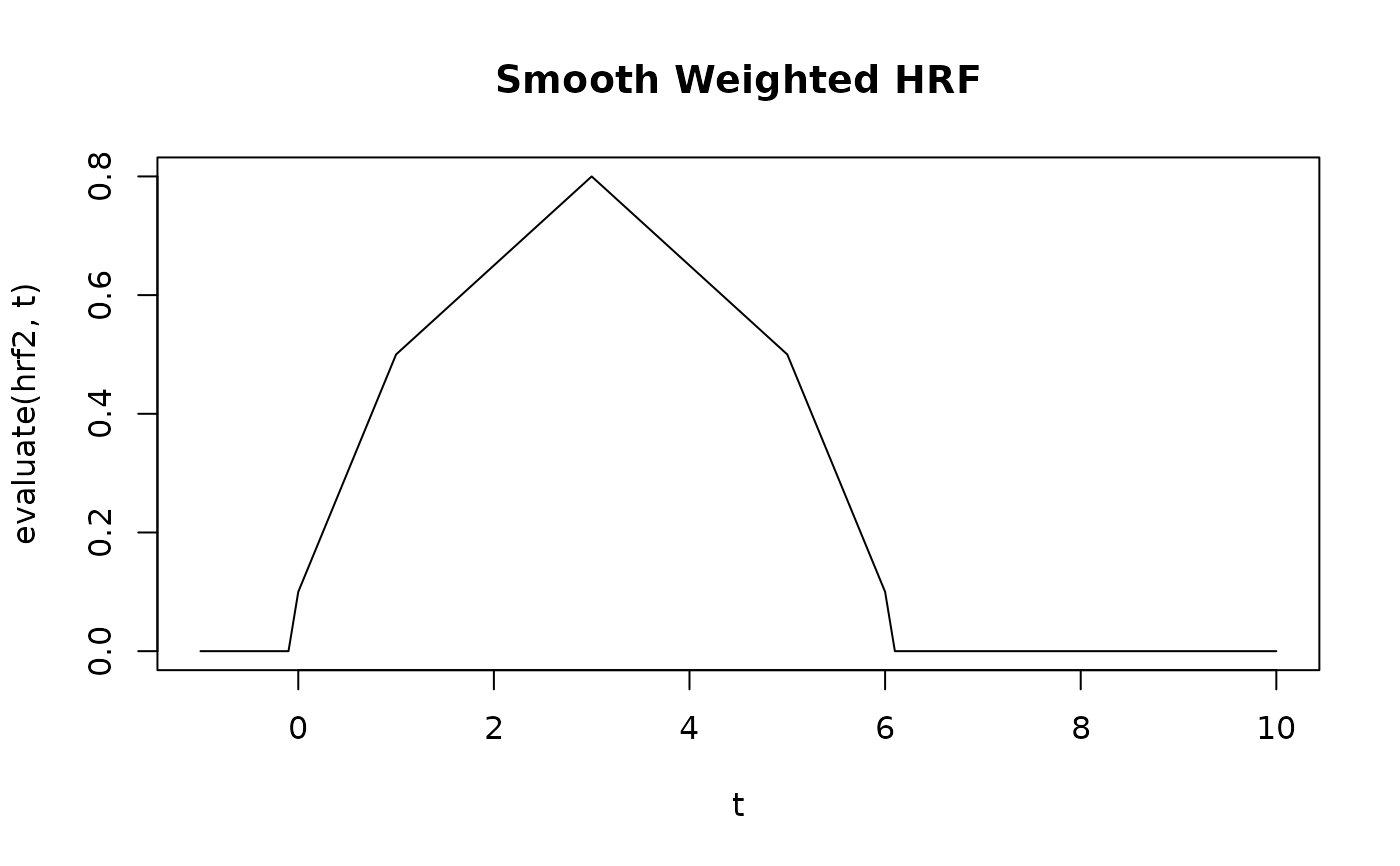
hrf2 <- hrf_weighted(
times = c(0, 1, 3, 5, 6),
weights = c(0.1, 0.5, 0.8, 0.5, 0.1),
method = "linear"
)
plot(t, evaluate(hrf2, t), type = "l", main = "Smooth Weighted HRF")
# Explicit times for precise control
hrf2 <- hrf_weighted(
times = c(0, 1, 3, 5, 6),
weights = c(0.1, 0.5, 0.8, 0.5, 0.1),
method = "linear"
)
plot(t, evaluate(hrf2, t), type = "l", main = "Smooth Weighted HRF")
 # Normalized weights: all four bin weights sum to 1
hrf3 <- hrf_weighted(
width = 8,
weights = c(1, 2, 2, 1),
normalize = TRUE
)
# Trial-varying weighted HRFs
hrf_early <- hrf_weighted(width = 6, weights = c(1, 1, 0, 0), normalize = TRUE)
hrf_late <- hrf_weighted(width = 6, weights = c(0, 0, 1, 1), normalize = TRUE)
reg <- regressor(onsets = c(0, 20), hrf = list(hrf_early, hrf_late))
# For delayed windows, use lag_hrf
hrf_delayed <- lag_hrf(hrf_weighted(width = 5, weights = c(1, 2, 1)), lag = 10)
# Normalized weights: all four bin weights sum to 1
hrf3 <- hrf_weighted(
width = 8,
weights = c(1, 2, 2, 1),
normalize = TRUE
)
# Trial-varying weighted HRFs
hrf_early <- hrf_weighted(width = 6, weights = c(1, 1, 0, 0), normalize = TRUE)
hrf_late <- hrf_weighted(width = 6, weights = c(0, 0, 1, 1), normalize = TRUE)
reg <- regressor(onsets = c(0, 20), hrf = list(hrf_early, hrf_late))
# For delayed windows, use lag_hrf
hrf_delayed <- lag_hrf(hrf_weighted(width = 5, weights = c(1, 2, 1)), lag = 10)