Getting Started with fmrismooth
fmrismooth authors
2025-08-28
intro.RmdThe goal of fmrismooth is to make practical, edge‑preserving
smoothing and denoising easy to apply to fMRI volumes and time series.
The package brings together fast lattice bilateral filters, robust and
TV‑based denoisers, MP‑PCA, and simple VST wrappers, with functions that
accept plain numeric arrays and optionally integrate with
neuroim2 if you work with
NeuroVol/NeuroVec objects. The examples below
use small synthetic arrays to keep the vignette self‑contained and fast
to run.
Quick start: one‑liner pipeline
The most convenient entry point is fmrismooth_default(),
which infers reasonable parameters from the data and optionally runs a
robust stage before a joint bilateral final stage.
library(fmrismooth)
library(ggplot2)

# helper to build a data.frame for a spatial slice (4D)
slice_df4d <- function(arr, z, t, label) {
  stopifnot(length(dim(arr)) == 4L)
  nx <- dim(arr)[1]; ny <- dim(arr)[2]
  df <- expand.grid(x = seq_len(nx), y = seq_len(ny))
  df$val <- as.vector(arr[,,z,t])
  df$method <- label
  df
}

dims <- c(8, 8, 8, 12)
clean <- array(100, dim = dims)
noisy <- clean + array(rnorm(prod(dims), sd = 4), dim = dims)

# One-liner with auto-parameters and joint bilateral final stage
smoothed <- smooth_auto(noisy, robust = "none", auto_params = TRUE)

c(var_original = var(as.vector(noisy)),
  var_smoothed  = var(as.vector(smoothed)))
#> var_original var_smoothed
#>     16.64967     13.54920

# visualize mid-slice of a mid-frame
zmid <- ceiling(dims[3]/2); tmid <- ceiling(dims[4]/2)
viz <- rbind(
  slice_df4d(noisy, zmid, tmid, "noisy"),
  slice_df4d(smoothed, zmid, tmid, "smoothed")
)
ggplot(viz, aes(x, y, fill = val)) +
  geom_raster() +
  scale_fill_gradient(low = "black", high = "white") +
  coord_fixed() +
  scale_y_reverse() +
  facet_wrap(~method) +
  theme_minimal(base_size = 10) +
  labs(title = "Mid-slice, mid-frame", x = NULL, y = NULL, fill = "intensity")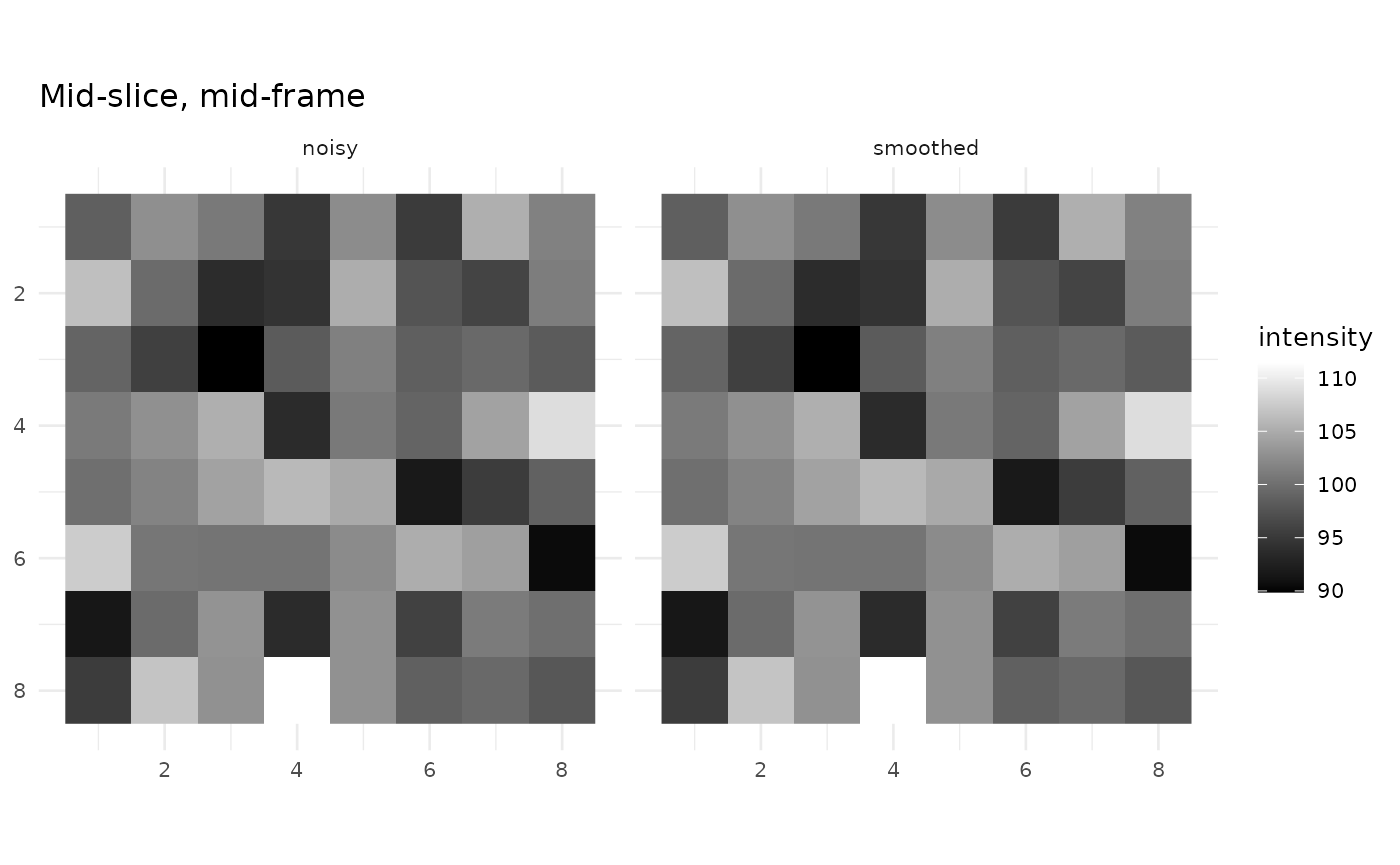
The default pipeline estimates spatial/temporal bandwidths and noise
scale from the data, then applies design‑aware joint bilateral smoothing
across space and time. If you have a T1 or probability maps, pass them
as guides; otherwise the spatial mean of the current estimate serves as
a weak guide. Note that range smoothing (sigma_r) only has
an effect when a guide (or guides) is supplied — without a guide the
filter is purely spatial.
MP‑PCA + joint bilateral
For stronger denoising while preserving structure, combine MP‑PCA
with joint bilateral filtering using
fmrismooth_mppca_pipeline().
mp_out <- smooth_mppca(
  noisy,
  sigma_mode = "global",   # estimate one sigma from temporal differences
  sigma_sp   = 2.5,
  sigma_t    = 0.5,
  sigma_r    = 12,
  lattice_blur_iters = 1L
)

c(var_original = var(as.vector(noisy)),
  var_mppca    = var(as.vector(mp_out)))
#> var_original    var_mppca
#> 16.649674935  0.007190354
This pipeline first denoises overlapping space×time patches with PCA, then smooths with a weakly temporal‑aware lattice bilateral filter. Where patches do not contribute (e.g., outside the mask), the original signal is preserved.
Joint bilateral filtering directly
If you want more direct control over bandwidths and guides, call
fast_bilateral_lattice4d() or its 3D counterpart.
# 4D joint bilateral with explicit parameters
jb <- bilat_lattice4d(
  noisy,
  sigma_sp = 2.0,
  sigma_t  = 0.6,
  sigma_r  = 10.0,
  guide_spatial = NULL,   # optional 3D guide; omit for self-guided
  guides = NULL,          # optional list of 3D guides (e.g., tissue probs)
  design = NULL,          # optional length-T regressor for design-aware feature
  mask = NULL             # optional 3D mask
)

all.equal(dim(jb), dims)
#> [1] TRUE
Under the hood, features are embedded in a permutohedral lattice;
values are splatted to lattice vertices, blurred along simplex axes, and
sliced back to the image grid. The range bandwidth sigma_r
can be a vector when using multiple guides.
Robust and TV‑based smoothing
When the goal is artifact suppression with minimal blurring, total variation methods and robust losses are often a good fit. The package exposes a straightforward TV denoiser and a robust variant.
# Space-time TV denoising (Chambolle-Pock)
tv <- tv_denoise4d(noisy, lambda_s = 0.6, lambda_t = 0.2, iters = 20L)

# Robust variant using Huber or Tukey data terms
rob <- tv_robust4d(noisy, loss = "huber", iters = 20L)

c(var_tv = var(as.vector(tv)), var_rob = var(as.vector(rob)))
#>    var_tv   var_rob
#>  5.274001 17.304458
The spatial and temporal TV weights (lambda_s,
lambda_t) trade off fidelity and smoothness; the robust
version internally sets thresholds from an estimated noise scale if not
provided.
Variance‑stabilizing transform wrapper
Magnitude MR data is Rician‑distributed. A simple yet effective
tactic is to apply a variance‑stabilizing transform (VST), denoise under
an approximate Gaussian model, then invert the transform. The
vst_wrap() helper encapsulates this pattern.
vst_out <- vst_denoise(
  noisy,
  denoise_fun = function(z) bilat_lattice4d(z, sigma_sp = 2.0, sigma_t = 0.4, sigma_r = 8)
)

c(var_vst = var(as.vector(vst_out)))
#>  var_vst
#> 0.186229
If sigma is not supplied and the input is 4D, the
wrapper estimates it from temporal differences in masked voxels.
Choosing parameters
Sensible defaults are helpful, but you might want parameters tied to
voxel size and TR. The recommend_params() helper looks at
spacing (when available), TR, and a global noise estimate, returning a
compact list you can pass into pipelines.
rec <- suggest_params(noisy, tr = 2.0, target_fwhm_mm = 5)
str(rec)
#> List of 5
#>  $ lambda_s: num 1.2
#>  $ lambda_t: num 0.159
#>  $ sigma_sp: num 1
#>  $ sigma_t : num 0.5
#>  $ sigma_r : num 5

out <- smooth_auto(noisy, robust = "none", auto_params = FALSE)
In practice, start with the default pipeline, check the variance
reduction and the appearance of edges in a few slices, then refine with
joint bilateral or TV methods if you need more control. All functions
accept plain arrays; if you work with neuroim2, spatial
alignment happens automatically when both the fMRI object and guides
carry space metadata.