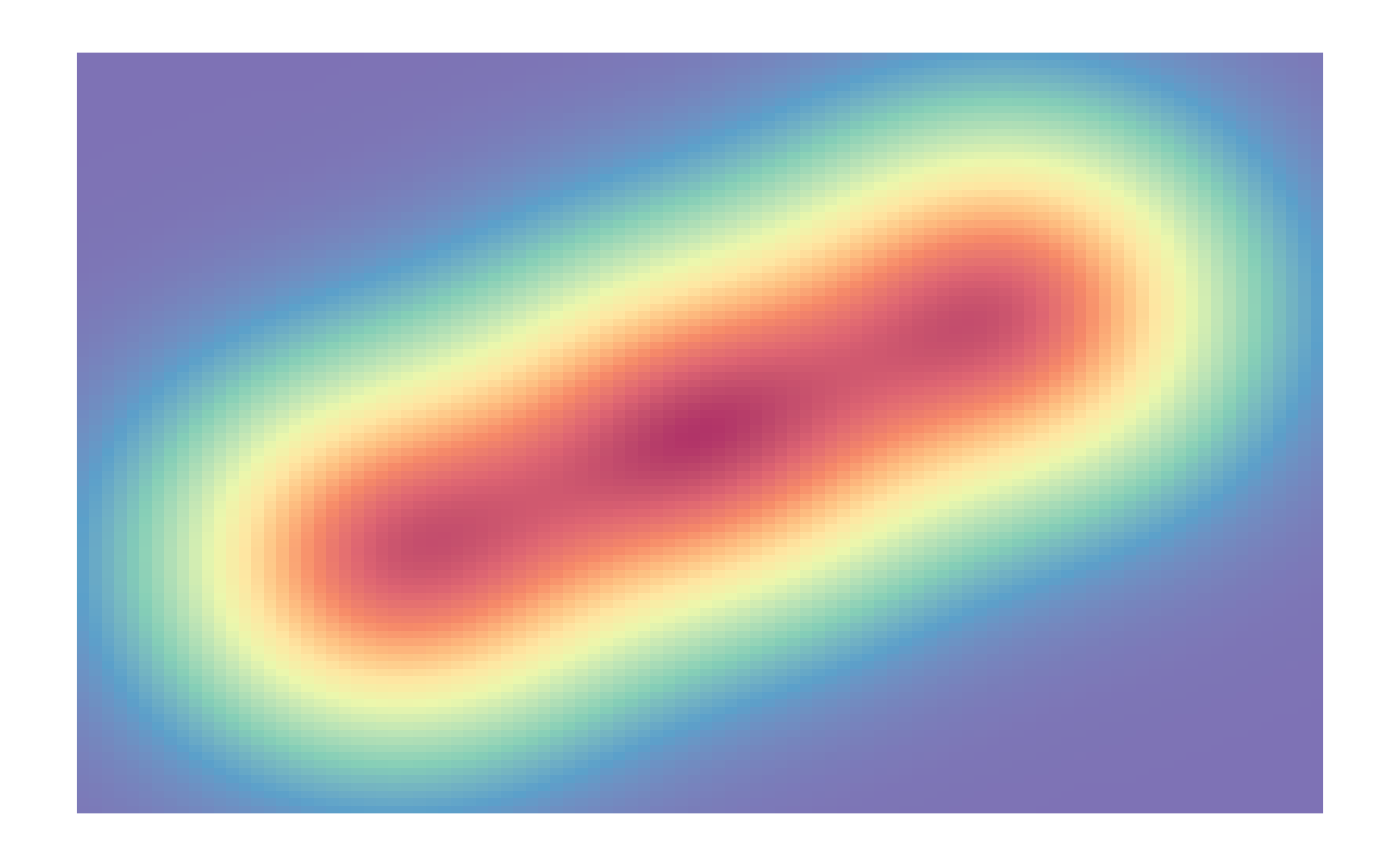
Draws a fixation density map on the shared eyesim density scale. Zero density is transparent, so a background stimulus shows through, and the map keeps the aspect ratio of its coordinate grid. Over a `bg_image`, thin white contour lines at five evenly spaced levels (from zero to the upper limit or the map's maximum) keep density edges visible.
Arguments
- x
An "eye_density" object.
- alpha
Maximum opacity of the density layer (default: 0.8); lower densities are progressively more transparent.
- bg_image
An optional image file name (or `cimg`) to use as the background.
- transform
The transformation to apply to the density values (default: c("identity", "sqroot", "curoot", "rank")).
- colours
Optional vector of colours for the density ramp (default: the eyesim density ramp).
- legend
Whether to show the density colour bar (default: `TRUE`).
- limits
Optional density limits for the colour scale (default: from zero to the map's maximum). Give several maps the same `limits` to compare them on one scale.
- ...
Additional args
See also
Other visualization:
anim_scanpath(),
element_text_wrap(),
eyesim_colours(),
plot.fixation_group(),
scale_fill_eyesim_density(),
theme_eyesim()
Examples
# Create a fixation group and compute eye density
fg <- fixation_group(x = c(100, 200, 300), y = c(100, 150, 200),
                     onset = c(0, 200, 400), duration = c(200, 200, 200))
ed <- eye_density(fg, sigma = 50, xbounds = c(0, 400), ybounds = c(0, 300))
# Plot the eye density
plot(ed)