What’s new in this release
- Token-driven design system
(
inst/tokens/albers-tokens.yml) now controls families, presets, and dark calibrations. - Deterministic composition blocks (
.albers-composition) add a signature visual motif. - Semantic callout variants (
callout-note,callout-insight,callout-warning,callout-experiment) are available. - Contrast validation now checks family/preset combinations against AA thresholds.
Semantic callouts
Use callout-note for neutral guidance.
Use callout-insight for interpretation and design
intent.
Use callout-warning when a choice has clear
tradeoffs.
Use callout-experiment for exploratory or provisional
guidance.
Contrast guardrail example
contrast_ratio <- function(fg, bg) {
  to_rgb <- function(x) as.numeric(grDevices::col2rgb(x)) / 255
  to_lin <- function(u) ifelse(u <= 0.03928, u / 12.92, ((u + 0.055) / 1.055)^2.4)
  luma <- function(x) {
    rgb <- to_rgb(x); lin <- to_lin(rgb)
    0.2126 * lin[1] + 0.7152 * lin[2] + 0.0722 * lin[3]
  }
  l1 <- luma(fg); l2 <- luma(bg)
  if (l1 < l2) { tmp <- l1; l1 <- l2; l2 <- tmp }
  (l1 + 0.05) / (l2 + 0.05)
}

ratio_structural <- contrast_ratio("#C22B23", "#e6e9ed")
ratio_adobe <- contrast_ratio("#C22B23", "#ece9e7")
stopifnot(ratio_structural >= 4.5, ratio_adobe >= 4.5)

data.frame(
  context = c("structural bg", "adobe bg"),
  ratio = c(ratio_structural, ratio_adobe)
)
#>         context    ratio
#> 1 structural bg 4.706474
#> 2      adobe bg 4.742774
Overview
- One family per page (A900/A700/A500/A300 → roles)
- Links + focus use AA tones; anchors reveal a typographic dash on hover
- Callouts and tables use quiet A300 tints; code blocks use a structural left ribbon
Palette families and roles
Families available: red, lapis, ochre, teal, green, violet. Each has four tones:
- A900: links and focus in light mode; strongest contrast
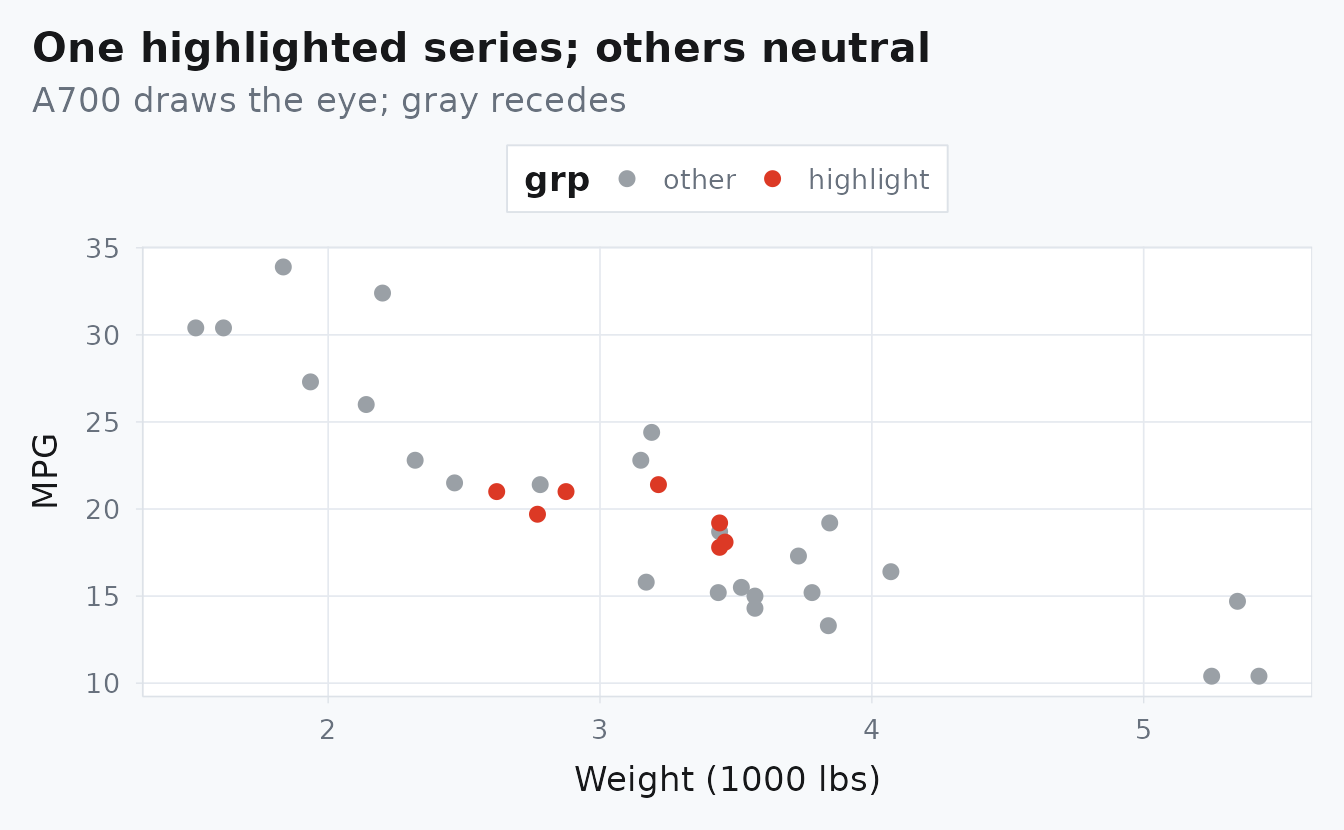
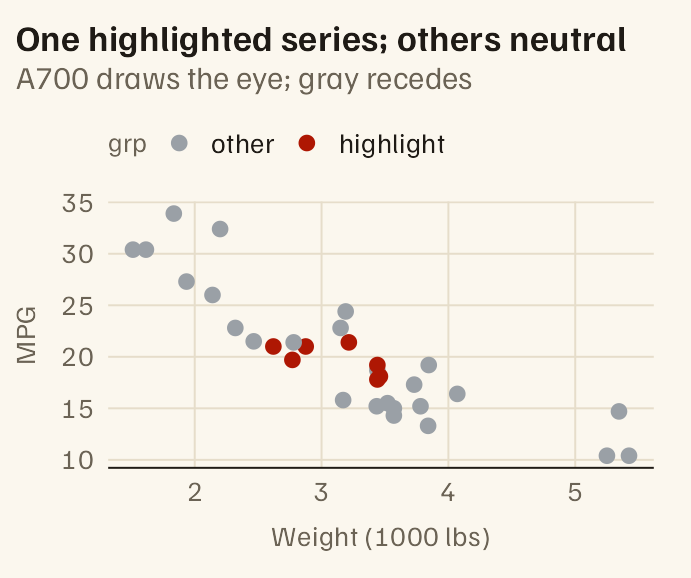
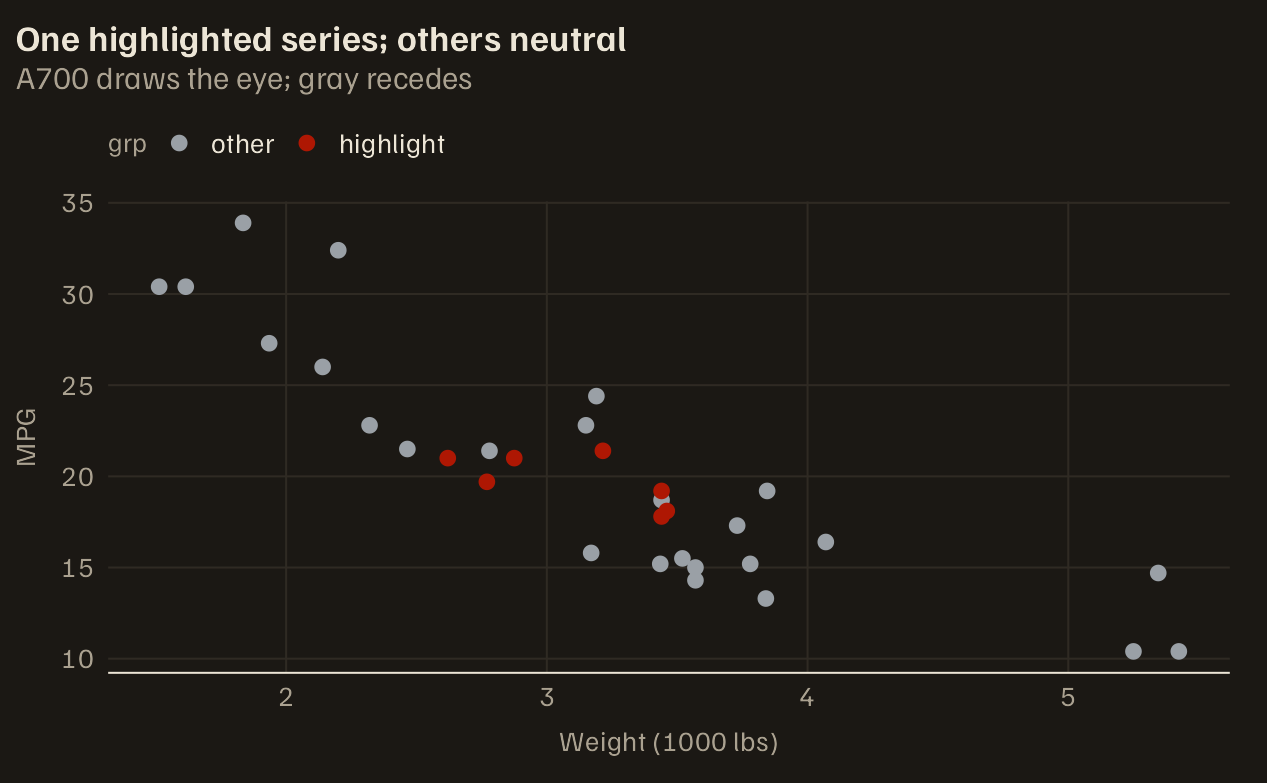
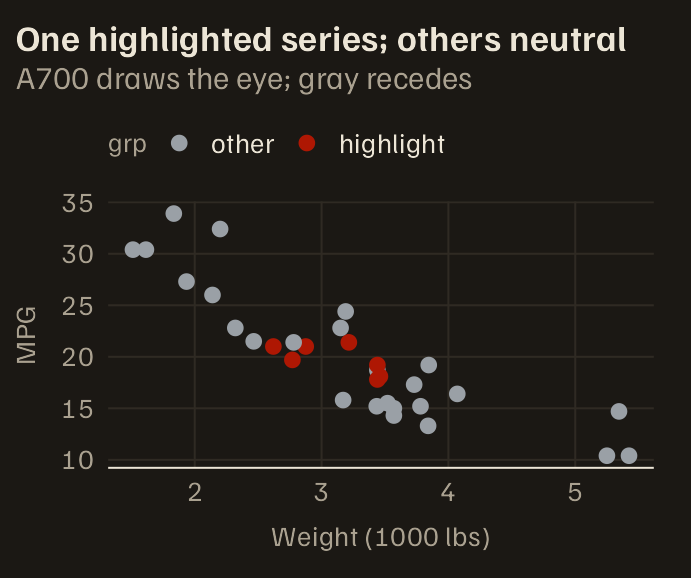
- A700: highlights (one series per plot); nav active marker
- A500: borders, dash anchors, code ribbons, structural rules
- A300: tints for callouts and table stripe; links/focus in dark mode
Image-derived palettes
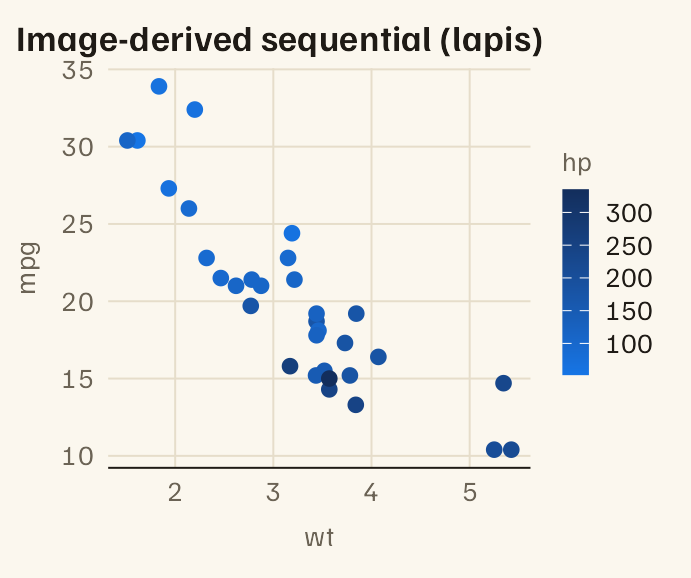
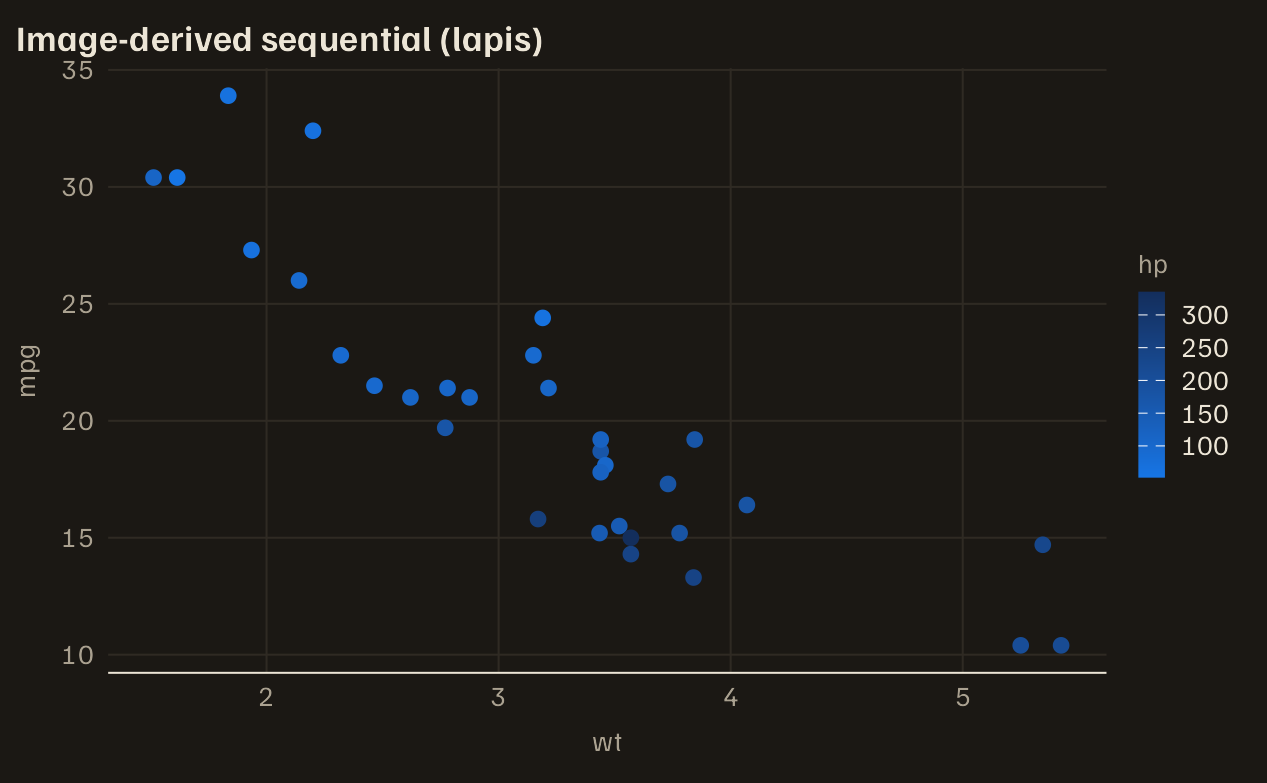
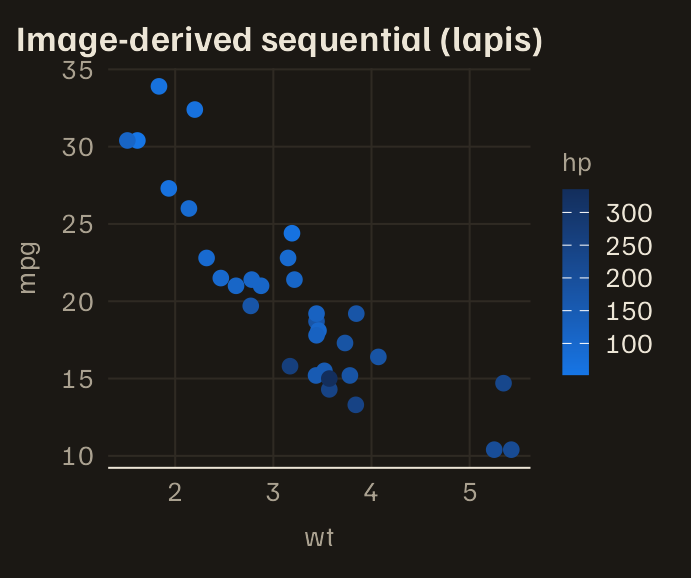
The original Homage families favor a single hue family per plot or page. When you want a different aesthetic (pulled from the grid image), use the image-derived palettes and scales. They mirror the API and are fully opt-in.
Sequential (image-based)
mtcars |>
  ggplot(aes(wt, mpg, colour = hp)) +
  geom_point(size = 2.2) +
  labs(title = "Image-derived sequential (lapis)") +
  albersdown::scale_color_albers_img(
    "lapis",
    discrete = FALSE,
    breaks = c(100, 150, 200, 250, 300)
  ) +
  ggplot2::guides(
    colour = ggplot2::guide_colorbar(
      title.position = "top",
      barheight = grid::unit(70, "pt"),
      barwidth = grid::unit(10, "pt")
    )
  ) +
  ggplot2::theme(legend.position = "right")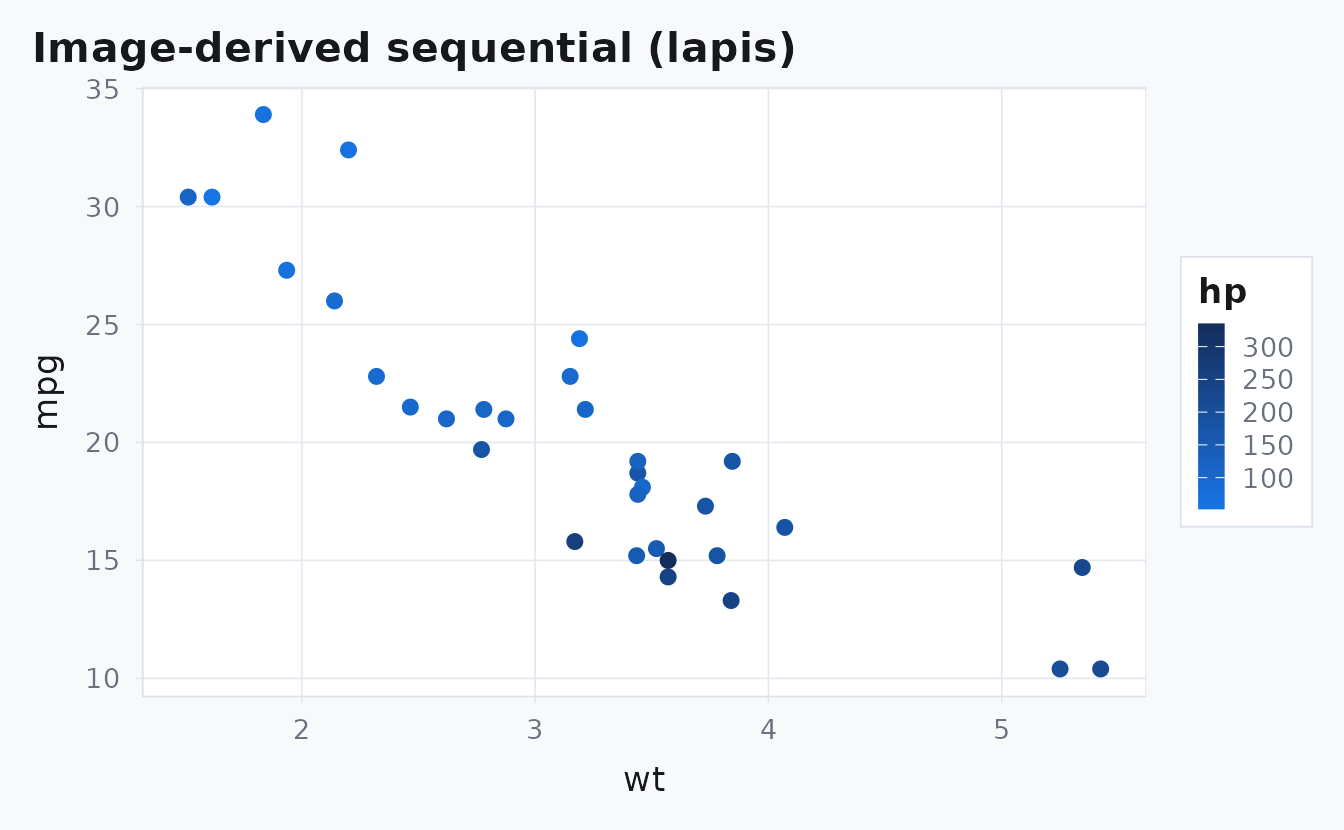
Diverging (image-based)
df <- transform(datasets::faithful, centered = waiting - mean(waiting))
ggplot(df, aes(eruptions, centered, colour = centered)) +
  geom_point(alpha = 0.9) +
  labs(title = "Image-derived diverging (red <-> teal)") +
  albersdown::scale_color_albers_img_red_teal(neutral = "#e5e7eb")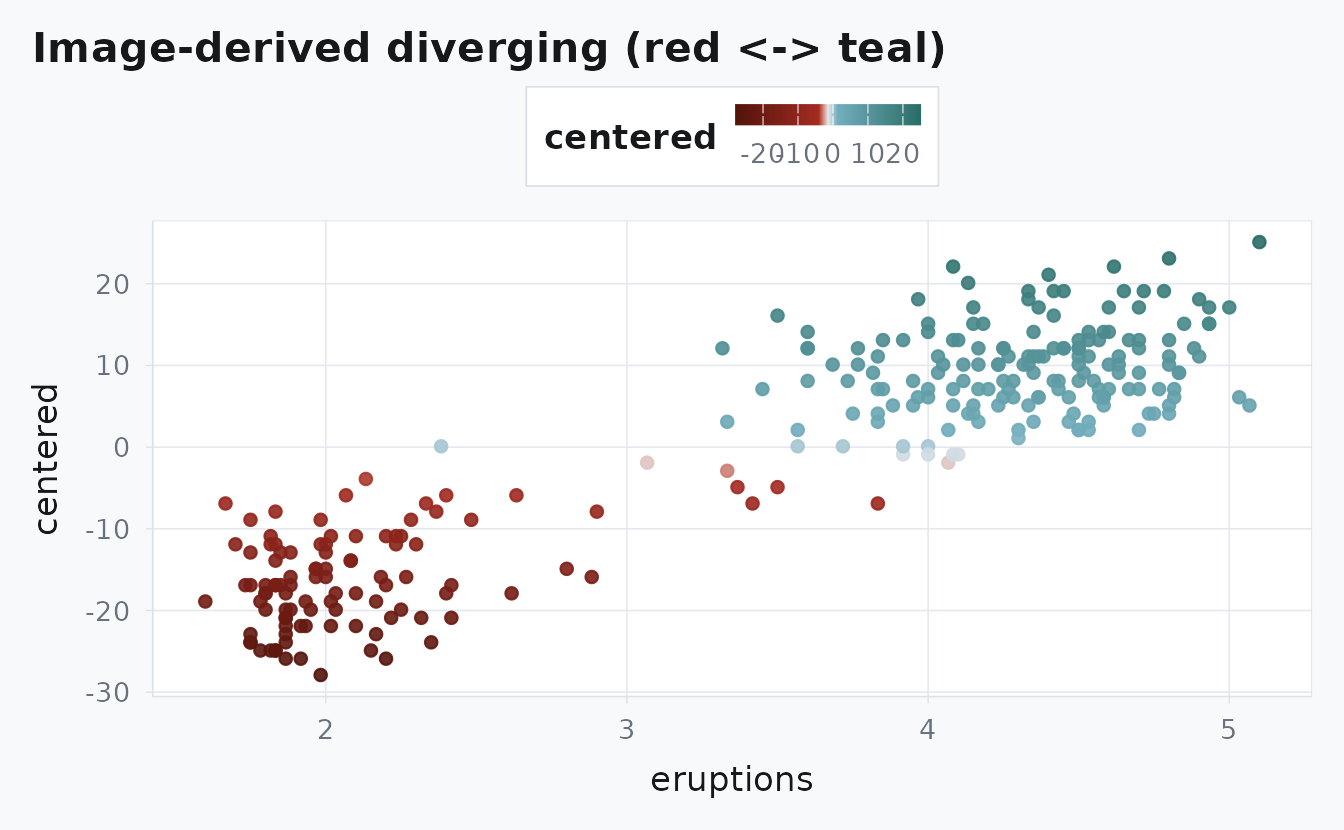
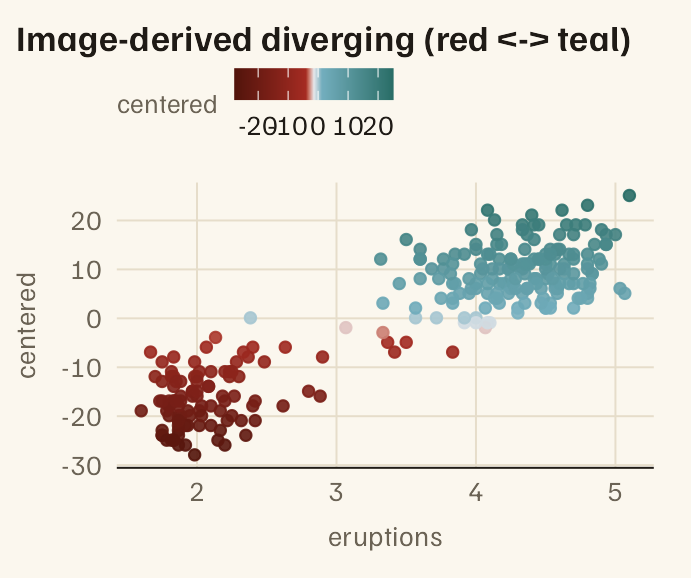
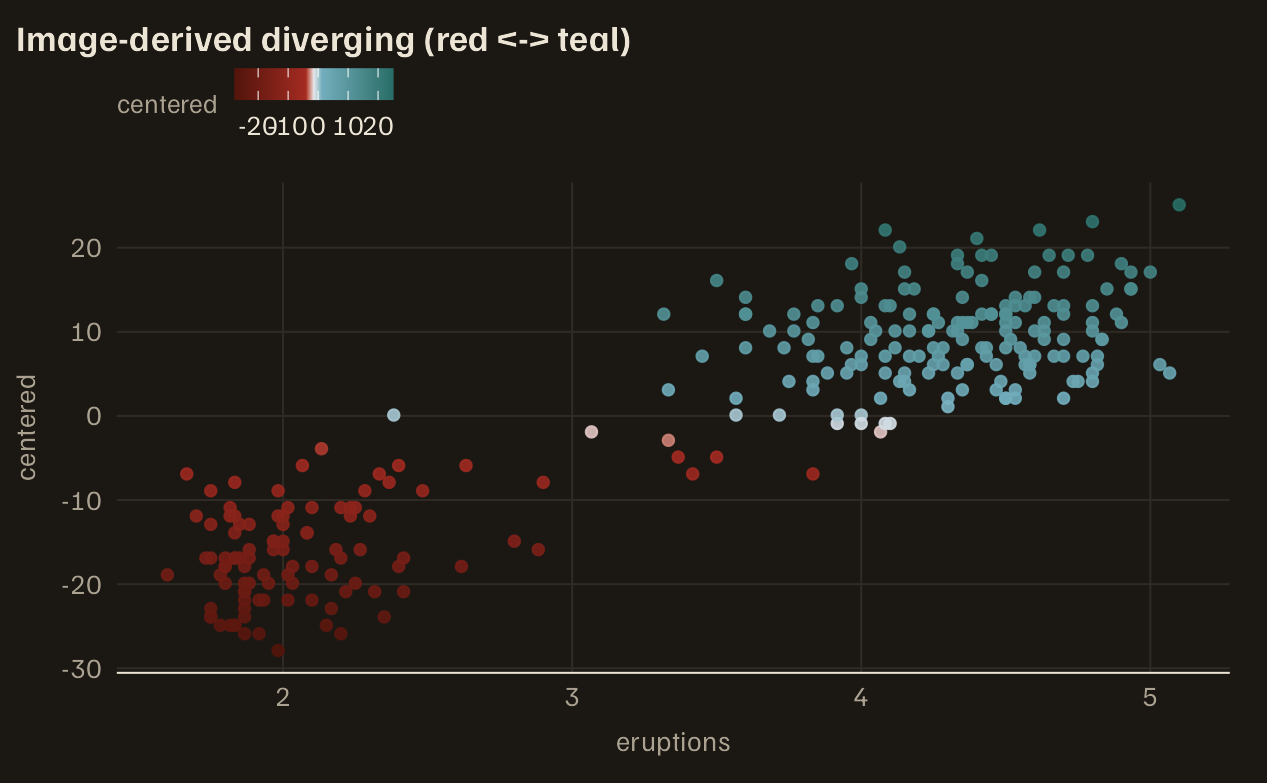
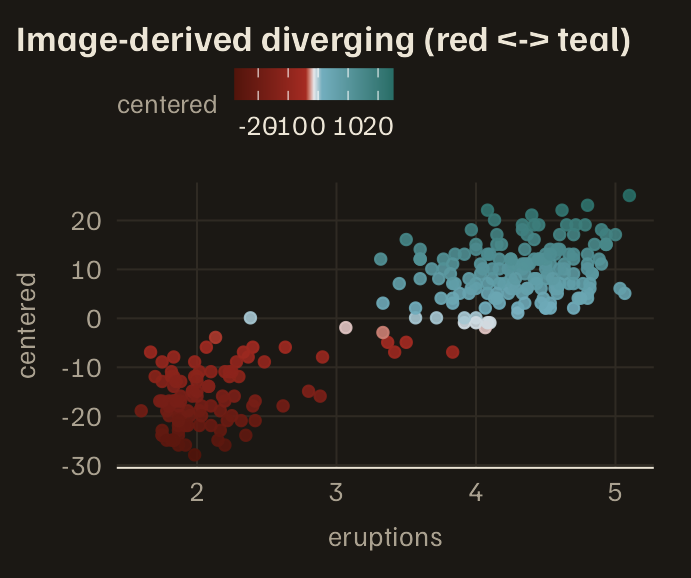
Notes - The *_img scales are opt-in and don’t change
existing defaults. - neutral can be set to
"#e5e7eb" (site border token) for visual coherence with
pages. - Prefer the original single-family scales for a quieter, unified
look; reach for the image-derived or diverging scales to emphasize
contrasts.
Links, anchors, and rhythm
Links and focus rings always meet AA. Move the cursor over H2/H3 to reveal the structural dash anchor.
Style modes - style: minimal (default): lighter rules
and quieter dash language. - style: assertive: stronger
edges and more emphatic structural marks.
Callouts and code blocks
TIP: Callouts use an A500 border and a subtle A300 tint (≈8–10%). Keep them short and purposeful.
# a small, readable function
foo <- function(x) if (length(x) == 0) NA_real_ else mean(x)
foo(c(1, 2, 3))
The code fence stays flat: no drop shadow, with an A500 left ribbon and a compact copy control.
Tables
Base HTML tables pick up a quiet A300 zebra stripe and thin borders.
| mpg | cyl | disp | hp | drat | |
|---|---|---|---|---|---|
| Mazda RX4 | 21.0 | 6 | 160 | 110 | 3.90 |
| Mazda RX4 Wag | 21.0 | 6 | 160 | 110 | 3.90 |
| Datsun 710 | 22.8 | 4 | 108 | 93 | 3.85 |
| Hornet 4 Drive | 21.4 | 6 | 258 | 110 | 3.08 |
| Hornet Sportabout | 18.7 | 8 | 360 | 175 | 3.15 |
| Valiant | 18.1 | 6 | 225 | 105 | 2.76 |
Plots: one highlight, others neutral
mtcars$grp <- ifelse(mtcars$cyl == 6, "highlight", "other")
mtcars$grp <- factor(mtcars$grp, levels = c("other", "highlight"))
ggplot(mtcars, aes(wt, mpg, color = grp)) +
  geom_point(size = 2.2) +
  albersdown::scale_color_albers_highlight(
    tone = "A700",
    highlight = "highlight",
    other_name = "other"
  ) +
  labs(title = "One highlighted series; others neutral",
       subtitle = "A700 draws the eye; gray recedes",
       x = "Weight (1000 lbs)", y = "MPG")